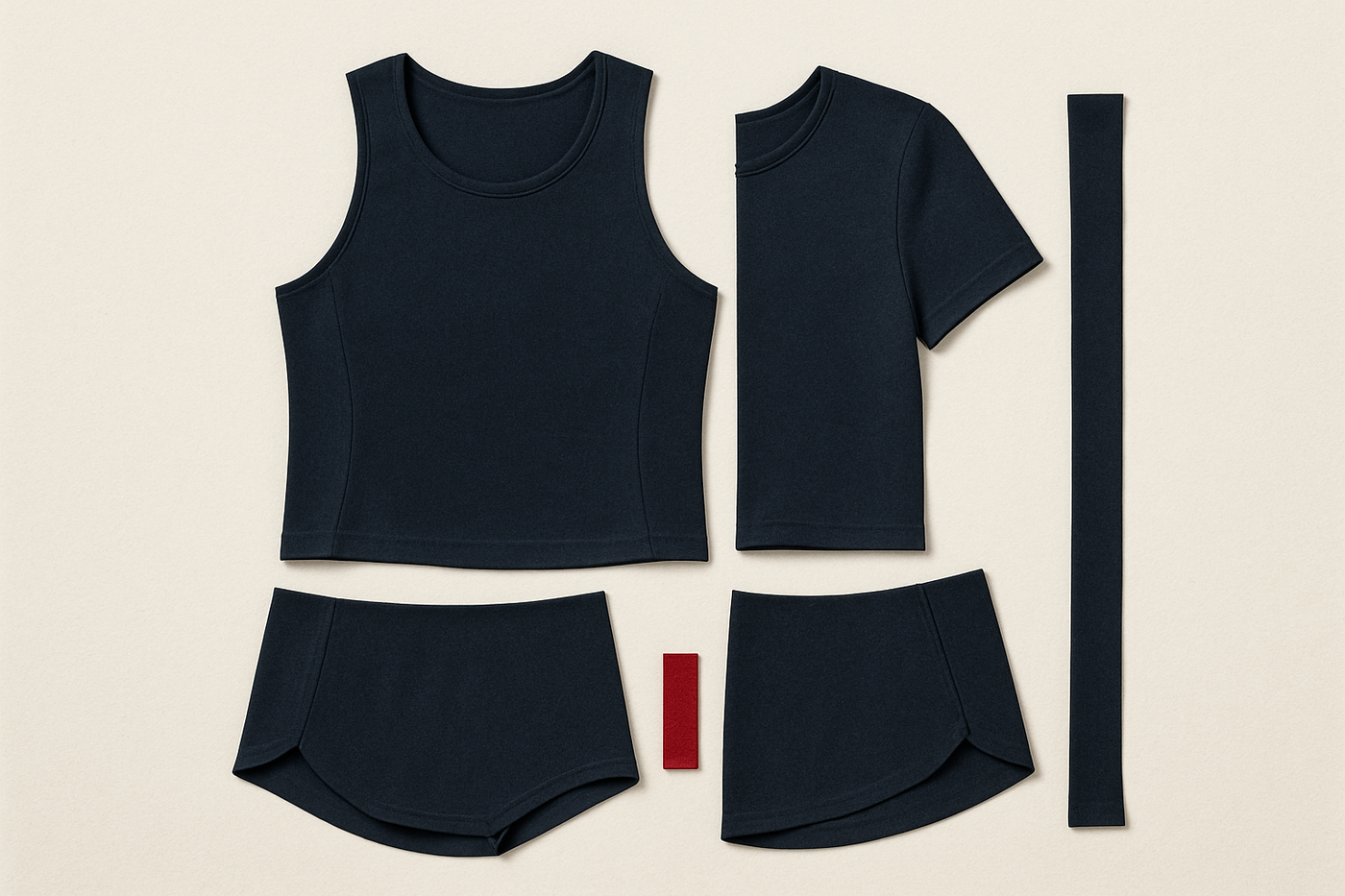
The running gear community has been watching something uncomfortable happen in slow motion. AI tools are generating performance apparel designs, colorways, silhouettes, technical details, print patterns, that look a lot like the work of the independent labels and small designers who built the aesthetic vocabulary of the space. The community notices. The lawyers haven't caught up yet.
This is the fashion IP problem that doesn't get enough attention outside specialist circles: the activewear and performance apparel space has extremely weak formal IP protection, and AI has made that weakness acute.
Why Performance Apparel Has Almost No IP Protection
Fashion design in the United States is famously hard to protect. The Copyright Office's position is that copyright requires human authorship, and that position was reaffirmed as recently as this year, when the Supreme Court declined to hear Thaler v. Perlmutter in March, leaving the D.C. Circuit's human-authorship ruling intact. For AI-generated designs, that means no copyright protection unless a human exercised meaningful creative control over the output. But the underlying problem for fashion designers predates AI: the "useful articles" doctrine means that clothing, including running gear, generally cannot be copyrighted at all, because it serves a functional purpose. Only design elements that can be conceptually separated from the garment's function qualify under Star Athletica v. Varsity Brands, and courts apply that test inconsistently.
Trade dress protection exists in theory. If your label has a sufficiently distinctive and recognized visual identity, you can potentially claim trade dress protection under the Lanham Act. But "sufficiently distinctive" is a high bar, and small independent brands rarely have the documented consumer recognition data needed to support a trade dress claim.
Utility patents cover technical innovations, a specific fabric construction, a proprietary seaming method, a functional detail that solves an engineering problem. But patents are expensive, slow, and require novelty. Most design elements in running gear don't qualify.
What AI Changes About This
The existing IP framework for fashion was inadequate before generative AI. AI makes it more inadequate in a specific way: scale and speed.
Previously, copying a small designer's work required human effort, someone had to see the design, understand it, and produce something similar. That created natural friction. A factory producing knockoffs at scale was visible and addressable. AI removes most of that friction. A model trained on publicly available images of running gear, including the lookbooks, campaign photography, and product images that independent designers post online, can generate variations of those designs at volume, quickly, without any human in the loop who made a conscious decision to copy anyone.
The legal question of whether training an AI model on a designer's published images constitutes infringement is genuinely unsettled, and the early rulings conflict. I keep a running overview in the AI copyright litigation map. California's AB 2013 training data transparency rules, in effect since January 2026, require developers to disclose in general terms what data was used to train their models, which creates at least a factual foundation for future claims. But disclosure is not the same as liability, and the cases that will actually test whether training on copyrighted images is infringement are still working their way through the courts.
The Running Gear Aesthetic Problem Specifically
Independent performance apparel designers tend to work in a space where aesthetic distinctiveness is the entire point. They are not competing on supply chain efficiency or price. They are competing on visual identity, a specific color sensibility, a relationship between technical function and graphic expression, a way of thinking about what running gear should look like that reflects a particular community's values.
That aesthetic is what's vulnerable. Not because anyone is necessarily copying in bad faith, but because AI models trained on the visual history of running gear will learn and reproduce the aesthetic vocabulary that the best independent designers created. The output may not copy any single garment. It may not be legally actionable under current doctrine. But the independent designer whose years of work helped create that vocabulary gets nothing, not attribution, not compensation, not protection.
The policy world knows this is a gap. WIPO has been running a multi-year consultation on IP and frontier technologies, including who should own AI-generated works, but there is no consensus and no binding international framework yet. A few states are moving on their own. Arkansas passed one of the first US state laws on AI-generated content ownership in April 2025, Act 927, which says the person who provides the input to a generative AI tool owns the output, provided the inputs were legally obtained and the output doesn't infringe anyone else's rights. That's a start, but it doesn't address the upstream question of whose work trained the model.
What Independent Designers Can Do Now
The honest answer is that the legal tools available right now are limited and imperfect. But a few practical steps are worth taking.
Document your creative process. Timestamped records of original design work, sketches, specification sheets, dated files showing the development of a design, establish provenance. In any future dispute about whether your work was used to train a model, documentation is the starting point. The provenance tool is built to make this a habit rather than a project.
Review what you've published and where. Every image you post online is potentially training data for someone's model. That doesn't mean you should stop publishing, visibility is necessary for independent designers, but it does mean being thoughtful about watermarking, resolution, and the terms of service on platforms where you post. Some platforms' terms of service include broad licenses that cover AI training. Read them. I go deeper on datasets and opt-outs in Your Designs Are Probably in an AI Training Dataset.
If you are licensing your designs to manufacturers or collaborators, make AI use an explicit part of the contract. What can they do with your design files? Can they use them to train internal AI tools? Can they feed them to AI systems for production optimization? These questions weren't in standard apparel licensing agreements two years ago. They should be now.
Watch the policy conversation, but don't wait for it. The WIPO process and the state-by-state experiments may eventually produce new registration or licensing mechanisms. Nothing binding exists yet. Being positioned to use those mechanisms if they arrive, knowing what you own and having documentation to prove it, matters more than predicting them.
The Bigger Picture
The running gear community's instinct that something is being lost when AI absorbs and reproduces independent design aesthetics is correct. The legal framework for addressing that loss doesn't fully exist yet. But the cases being litigated now, on training data, on AI-generated output, on likeness and voice, are building the doctrine that will eventually apply here too.
Independent designers who understand what's at stake, document what they own, and write contracts that account for AI use are in a better position than those who don't. That's the available move right now. It's not enough. But it's real.
Sources
- US Copyright Office, Copyright and Artificial Intelligence
- Thaler v. Perlmutter, Supreme Court docket No. 25-449
- Star Athletica v. Varsity Brands, 580 U.S. 405 (2017)
- California AB 2013 (bill text)
- WIPO Conversation on IP and Frontier Technologies
This article is editorial analysis, not legal advice. For questions about your specific situation, consult a qualified attorney.