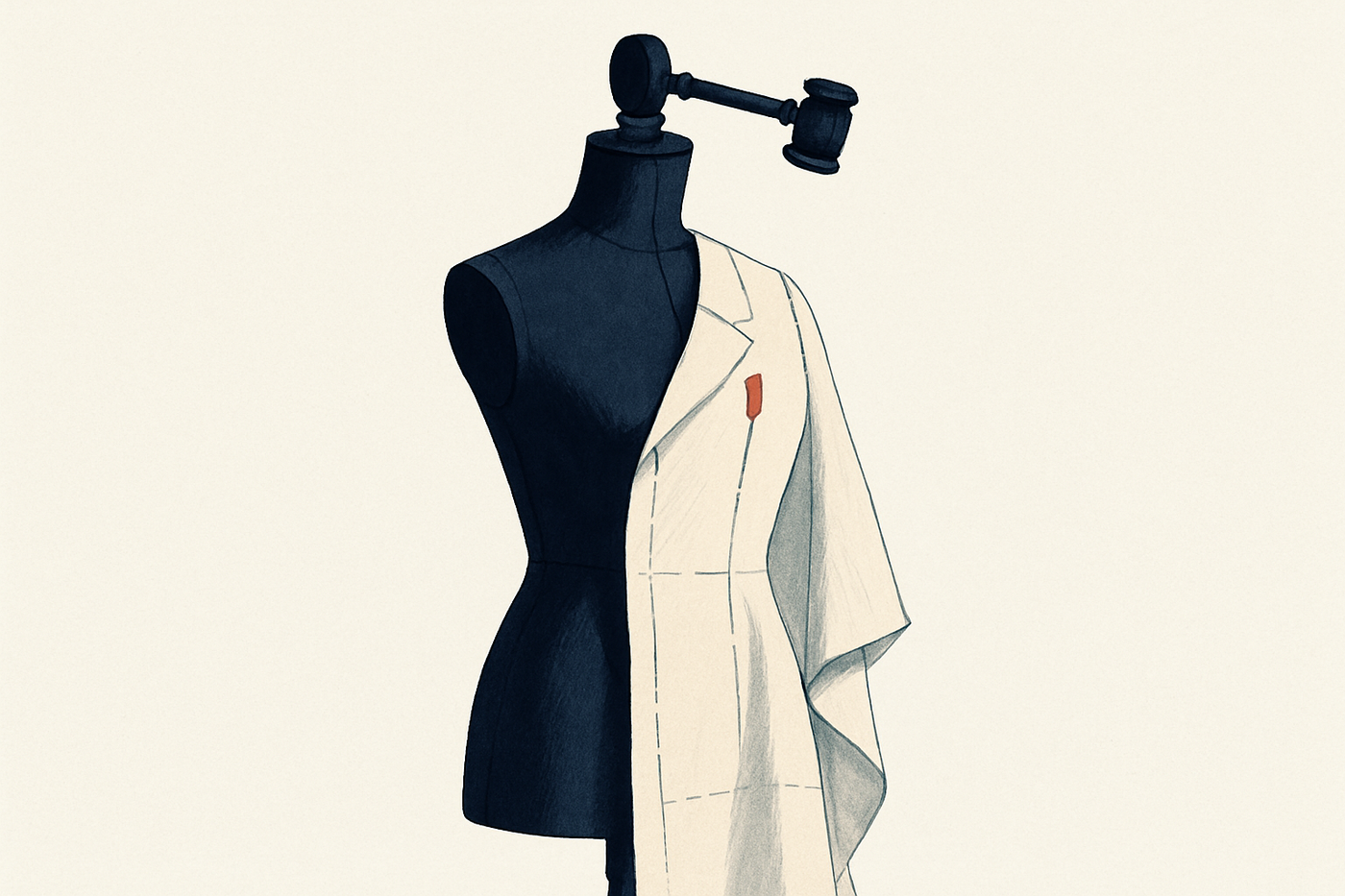
New York's synthetic performer law is not coming, it's here. Governor Hochul signed it (Senate bill S8420-A, enacted as A8887-B, Chapter 617 of the Laws of 2025) on December 11, 2025, and it took effect on June 9, 2026. It amends General Business Law section 396-b to require a conspicuous disclosure whenever an advertisement includes an AI-generated "synthetic performer." Together with the digital replica rules of the Fashion Workers Act, in force since June 19, 2025, it is the clearest articulation yet of what fashion brands owe the humans, real and simulated, who appear in their campaigns. And the combined framework is broader than most brands realise.
Two laws, two different questions
I want to be precise here, because I keep seeing these two laws blurred together.
The synthetic performer law asks: is the "person" in your ad real? If not, you must say so, conspicuously, in the ad itself.
The Fashion Workers Act asks: did a real model consent, in writing, before you created or used a digital replica of them? If not, you have a problem regardless of any disclosure.
One is about consumer-facing disclosure. The other is about consent from talent. A fashion brand using AI imagery can trip over either, or both.
Who counts as a "synthetic performer"?
The statute defines a synthetic performer as a digitally created asset, created, reproduced, or modified by computer using generative AI or a software algorithm, that is intended to create the impression of an audiovisual or visual performance by a human performer who is not recognizable as any identifiable natural person.
In plain English: the fully AI-generated model. If you use Midjourney, DALL-E, or a similar tool to generate a photorealistic person and put that image in a commercial advertisement, New York now requires you to disclose it conspicuously in the ad. The reach is wider than generative AI alone, though: because the definition also covers an asset made by "a software algorithm," it can capture a traditionally computer-generated digital human, not only an AI-generated one.
The penalties are modest but real: civil penalties of $1,000 for a first violation and $5,000 for each subsequent violation. For an independent brand running a multi-image campaign, that adds up quickly.
There are exemptions worth knowing. Audio-only ads are not covered. Neither is AI used solely to translate a real performer's speech into another language. And ads for films, television, streaming content, and video games are exempt where the synthetic performer's use in the ad matches its use in the underlying work.
What about AI-altered real models?
This is where the Fashion Workers Act does the work, and where the law is broader than most brands anticipate.
The Act, enacted as S9832-A (Chapter 683 of the Laws of 2024) and effective June 19, 2025, requires clear written consent before creating or using a model's "digital replica." The definition covers any significant, computer-generated or AI-enhanced representation of a model's likeness, face, body, or voice, that substantially replicates or replaces the model's appearance or performance.
Routine photographic edits, colour correction, minor retouching, standard post-production, are expressly excluded. What the law reaches is the use of AI to create a version of a person that materially differs from who they are. AI changes to body proportions, body shape, or facial structure sit squarely in the zone the law was written for. The question is not whether a human pressed a button. The question is whether AI substantially altered or replaced the depiction of a real person without their written, informed consent.
Model agencies must also obtain a model's written approval for digital replica use separately from the representation agreement. Enforcement runs through the New York State Department of Labor and the Attorney General, and an aggrieved model has a private right of action. I cover the full statute in my guide to the Fashion Workers Act.
What written consent must include
Under the Fashion Workers Act, consent to a digital replica must be specific. Generic photography release language that does not address AI does not satisfy it. The written approval must spell out the scope and purpose of the replica's use, the rate of pay, and how long the replica will be used.
My practical advice goes a step further:
Describe the specific AI use contemplated. Not "the brand may use AI" but "the brand may use generative AI tools to [specific uses] in [specific contexts]." The more specific, the better protected you are.
Get separate consent for each material type of AI use. Consent to AI background replacement is not consent to AI body alteration. Address them separately.
Include a revocation mechanism. The statute does not spell one out, but a clear process for a model to withdraw consent for future uses, with a reasonable notice period, is fair and it protects you from disputes.
State compensation clearly. The Act requires the rate of pay for replica use to be in the agreement. Fair market value for the specific use is the standard I'd aim for.
What your model contracts need right now
If you use AI anywhere in campaign production that touches images of real people, retouching, background generation, product visualisation built on model photography, your contracts need review. The additions I recommend: an AI use disclosure clause requiring notice to the performer before AI is applied to their image; separate, explicit consent for body alteration, facial alteration, and synthetic extension; a revocation process with notice periods; and specific compensation for AI uses beyond the original shoot.
And if any campaign imagery features a fully synthetic performer, build the conspicuous disclosure into your creative process now, not at the media-buy stage.
The overlap with other laws
New York's framework operates alongside California's AB 2602, which makes digital replica provisions in service contracts unenforceable unless the uses are reasonably specific and the performer had legal or union representation, and AB 1836, which protects digital replicas of deceased personalities. Both took effect January 1, 2025. Federally, the FTC's rule on consumer reviews and testimonials bans AI-generated testimonials from people who do not exist, with civil penalties that can reach five figures per violation.
These frameworks are compatible but not identical. Consent under one does not guarantee compliance under another. If you work with talent in New York, California, or both, as most fashion brands do, you need language that satisfies all of them in a single well-drafted agreement. I track new state laws in this space on the legislation tracker, and if you're thinking about AI versions of influencers and creators specifically, start with Who Owns You?.
This article is editorial analysis, not legal advice. For questions about your specific situation, consult a qualified attorney.