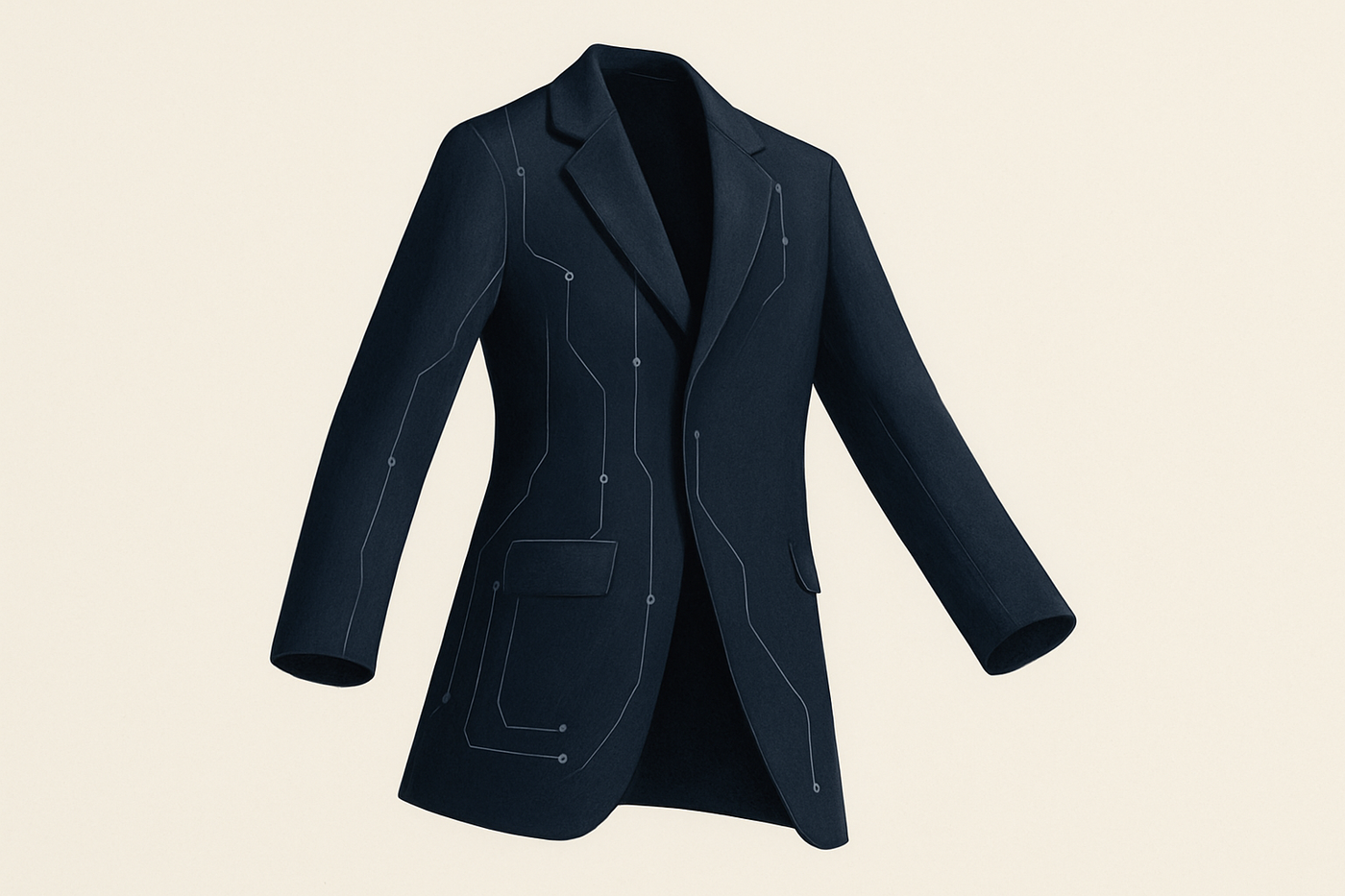
Wearable technology has had a false start problem. For fifteen years, the promise was garments that do something, track biometrics, change colour, respond to environment. The execution was rigid PCBs sewn into soft garments, battery packs at the waist, LED arrays that nobody could wash. The 2010s wearable tech moment produced products that were impressive as demonstrations and difficult to wear as clothing.
The current moment is different. Conductive thread, pressure-sensing yarn, temperature-responsive materials, and body-area networking have matured to the point where independent designers can build sensing garments that look and feel like garments. Not garments with technology attached. Garments that are, in their material structure, technological.
What's actually changed
Three developments have converged to enable this shift:
Material advances. Conductive thread is now available at sufficient conductivity and washability for practical garment use. Thermochromic and photochromic materials have improved dramatically in durability and predictability. Piezoelectric fibres that generate electrical signal from mechanical pressure have reached commercial availability at craft-accessible prices. Suppliers like SparkFun and Adafruit have brought these materials into reach for independent studios.
Accessible electronics. Miniaturisation has reached the point where the electronic components of a sensing garment can be invisible, embedded in seams, hidden in structural elements, integrated into closures. Combined with wireless protocols designed for body-area networks, the result is sensing garments that don't look like they contain electronics.
Open-source toolchains. This is the enabling development for independent designers specifically. Open-source tools, including embroidery software like Embroider Modder and the LilyPad Arduino ecosystem, have brought the prototyping stack into studios without lab infrastructure. A designer can now build and test a pressure-sensitive garment prototype with hardware costs under $200 and freely available software.
What independent designers are making
Biometric-responsive silhouette. Garments that respond to the wearer's physical state, heart rate, breath rate, movement intensity, to alter their appearance or structure. The technical challenge is making these responses feel intentional and elegant rather than arbitrary.
Pressure-sensitive surface detail. Embroidery and surface decoration that responds to touch, changing colour, emitting light, or triggering wireless signals when contacted. The commercial application includes authentication (only the genuine garment responds correctly) and interaction design (garments as interfaces).
Temperature-responsive material treatments. Surface treatments and embedded materials that shift appearance with body or environmental temperature. These create garments that are genuinely different objects in different conditions.
Environmental sensing. Garments that respond to air quality, UV index, humidity, creating wearable personal environmental monitors that don't look like monitoring devices. Several designers in this space are working with public health researchers on applications beyond fashion.
The data question: your garment is now a data collector
Here's the part of this that fashion law training does not prepare anyone for. The moment your garment senses heart rate, breath, movement, or body geometry, you are collecting personal data, possibly biometric data, and a growing body of law applies.
Illinois's Biometric Information Privacy Act is the one that should focus your attention. BIPA requires informed written consent before collecting biometric identifiers, carries statutory damages of $1,000 per negligent violation and $5,000 per intentional or reckless one, and gives individuals a private right of action. A 2024 amendment softened the worst exposure, repeated collection of the same identifier by the same method now counts as a single violation, and in April 2026 the Seventh Circuit held that limit applies retroactively to cases already pending when the amendment took effect, in Clay v. Union Pacific Railroad Co., Nos. 25-2185, 25-2761 and 25-2762 (7th Cir. Apr. 1, 2026). It is still the strictest biometric law in the country. Texas and Washington have their own biometric statutes, and Washington's My Health My Data Act sweeps in health-adjacent data, which plausibly includes the heart rate and exertion data a responsive garment reads, with its own private right of action.
If you sell in Europe, the GDPR treats biometric and health data as special category data requiring explicit consent, and the EU AI Act adds rules for emotion recognition and biometric categorisation systems. I cover what that means for fashion in my EU AI Act guide.
The practical baseline for a sensing garment: know exactly what data it collects, keep processing on the device where you can, get real consent before anything biometric leaves the garment, and write a privacy notice a customer can actually understand.
Product liability: when clothing becomes a product that can fail
A garment with electronics in it can fail in ways a garment cannot: overheating, battery issues, sensor malfunction, software bugs. In the US, that puts you in ordinary product liability territory, design defect, manufacturing defect, failure to warn, plus Consumer Product Safety Commission oversight for consumer products.
The EU has gone further. The new Product Liability Directive (EU) 2024/2853 explicitly treats software as a product and applies to products placed on the EU market after December 9, 2026. For connected wearables, that means liability can attach to firmware and companion apps, not just the physical garment, and failing to supply needed software updates can itself make a product defective. If you plan to sell sensing garments in Europe from 2027 onward, build update capability and documentation into the product now.
The IP moment, and why it matters right now
Here's what most independent designers building in this space are not adequately focused on: the IP window.
First patent filings in the independent e-textile space are beginning to appear. The window to establish priority in specific novel methods, a particular construction technique for integrating sensing into a seam, a specific approach to washable conductivity in embroidery, a novel method of coupling biometric signal to visible material response, is open. It won't stay open indefinitely.
The mistake everyone makes is thinking patents are for after you've built the business. Patents are for when you've identified the novel method. The right time to file is before your collection goes to press, not after.
Utility patent protection requires novelty, non-obviousness, and utility. Design patent protection covers the aesthetic appearance. The USPTO has resources specifically for small businesses and independent inventors navigating the filing process.
The timing challenge specific to fashion: collections are publicly shown at trade shows like Coterie and Première Vision, and in press, before they go to market. Public disclosure before a patent application is filed can destroy novelty. In the US, Section 102(b) gives inventors a one-year grace period for their own disclosures. Europe is far less forgiving: the European Patent Convention has no general grace period, so showing your method publicly before filing generally kills your European patent rights. And third-party disclosure, someone else publishing your method, gets no grace period protection in most jurisdictions.
The practical implication: if you have a novel technical method in an e-textile or wearable design, consult patent counsel before showing it publicly, including trade show presentations, press previews, or social media.
The collaboration landscape
The most interesting work in independent wearable tech is happening at the intersection of fashion design, materials science, and electronics engineering, which means collaboration across disciplines is essential and IP agreements become immediately important.
When a fashion designer collaborates with a materials scientist or engineer on an e-textile product, the questions to settle before work begins: who owns the resulting IP, how it is owned (jointly, or assigned to one party), what happens if one party leaves, and what rights each party has to use jointly developed methods elsewhere.
These questions are not difficult to address in a well-drafted collaboration agreement. They are very difficult to address retroactively, once a collaboration has produced commercially valuable results and the parties have divergent expectations.
Registration and protection checklist
For designers building in this space, the minimum protection framework:
- Document every novel method, construction technique, and technical approach as it's developed, with date stamps and clear records of who developed what. The provenance toolkit works for technical development records too.
- Consult patent counsel before any public disclosure of technically novel work. Even a brief consultation is far cheaper than discovering a filing window has closed.
- Register copyright in distinctive aesthetic designs, including surface patterns, with the Copyright Office at the time of creation rather than waiting for a dispute.
- Use collaboration agreements that address IP ownership explicitly before any joint work begins.
- Map your data flows before launch: what the garment senses, where it goes, and which biometric and health data laws apply in the states and countries where you sell. I keep current developments on the tracker.
- Implement trade secret protection for production methods that can practically be kept confidential, including NDAs with production partners and restricted access to process documentation.
For how these sensing materials fit into the broader computational design picture, see Generative Design Tools in Fashion.
This article is editorial analysis, not legal advice. For questions about your specific situation, consult a qualified attorney.
Corrections
Updated September 3, 2026. The April 2026 Seventh Circuit decision on the retroactivity of the 2024 BIPA amendment was described here but never named. It is Clay v. Union Pacific Railroad Co., Nos. 25-2185, 25-2761 and 25-2762 (7th Cir. Apr. 1, 2026), and it is now cited. The holding as described was accurate; only the citation was missing.
This article is editorial analysis, not legal advice. For questions about your specific situation, consult a qualified attorney.